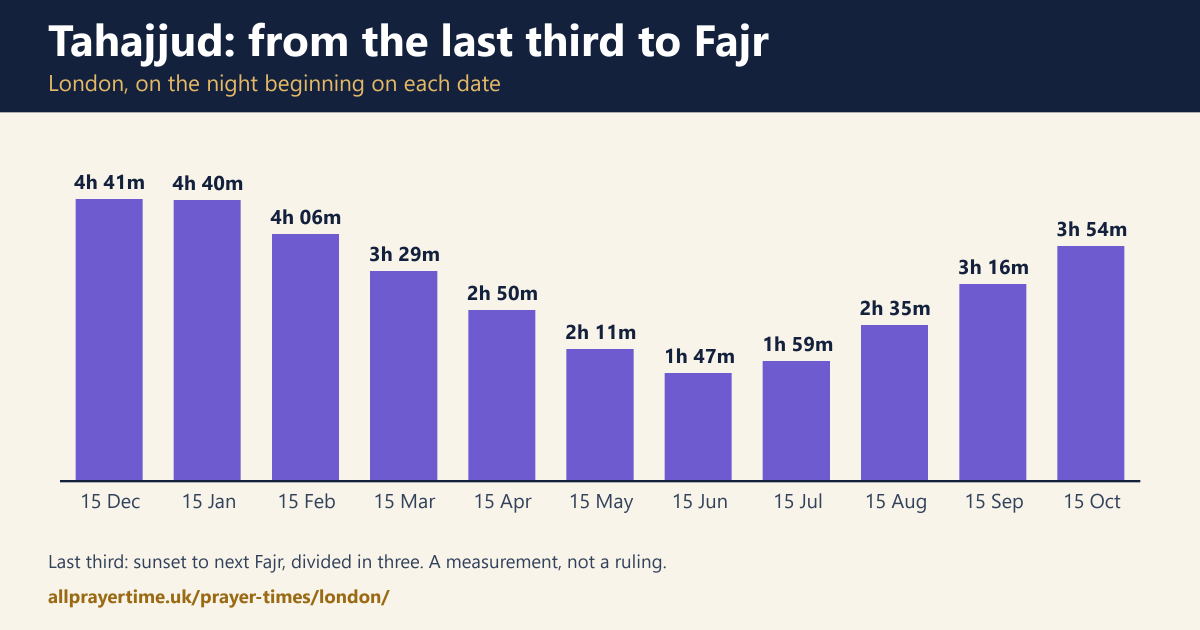
Tahajjud is a voluntary night prayer, prayed after Isha and before Fajr. Its most praised part is the last third of the night. In London on the night after Friday 15 January 2027, the last third begins at 01:39 and Fajr is at 06:19, a window of 4h 40m.
We publish no "Tahajjud time". What we publish is when the last third of the night begins, which is a measurement. This guide is not a religious ruling. For a question of fiqh, ask a qualified scholar, and follow your local mosque.
When can Tahajjud be prayed?#
The Qur'an says: "And from [part of] the night, pray with it as additional [worship] for you; it is expected that your Lord will resurrect you to a praised station" (17:79, Saheeh International).
A SeekersGuidance answer by Shaykh Yusuf Weltch gives the time of Tahajjud as from after Isha until the Fajr prayer time enters. A second answer on the same site distinguishes two names: a voluntary prayer any time after Isha is qiyam al-layl, and one prayed after first sleeping is Tahajjud. These are Hanafi answers; ask your own scholar how your school treats it.
The best time: what the sources say#
- Abu Huraira reported that the Prophet ﷺ said that our Lord descends to the nearest heaven every night "when the last third of the night remains", asking who will call on Him, ask of Him or seek His forgiveness (Sahih al-Bukhari 1145).
- The Prophet ﷺ described the prayer of Dawud (David): he slept half the night, prayed for a third of it and slept for a sixth (Sahih al-Bukhari 1131).
- One SeekersGuidance answer says the best time is the last third, and that praying at any time of the night is permissible and rewarding. Another places the most virtue just before Fajr enters.
How the last third is worked out#
We measure the night from sunset to the next morning's Fajr and divide it into three; the last part is the final third. The SeekersGuidance answer measures from the Maghrib prayer instead, which in our calculated cities is 3 minutes after sunset and moves the result by about a minute. The full method, including nights when the clocks change, is in Islamic midnight and the last third of the night.
London: Isha, last third and Fajr through 2027#
Each row is the night that begins on the date shown, so Fajr is the next morning. December 2026 is our calculated timetable; 2027 rows are the London Unified Prayer Timetable's Isha and Fajr.
| Night of | Isha | Last third begins | Fajr (next morning) | Last third to Fajr |
|---|---|---|---|---|
| 15 Dec 2026 | 17:49 | 01:15 | 05:56 | 4h 41m |
| 15 Jan 2027 | 18:00 | 01:39 | 06:19 | 4h 40m |
| 15 Feb 2027 | 18:48 | 01:27 | 05:33 | 4h 06m |
| 15 Mar 2027 | 19:28 | 01:03 | 04:32 | 3h 29m |
| 15 Apr 2027 | 21:14 | 01:38 | 04:28 | 2h 50m |
| 15 May 2027 | 21:58 | 01:08 | 03:19 | 2h 11m |
| 15 Jun 2027 | 22:43 | 00:52 | 02:39 | 1h 47m |
| 15 Jul 2027 | 22:23 | 01:10 | 03:09 | 1h 59m |
| 15 Aug 2027 | 21:33 | 01:33 | 04:08 | 2h 35m |
| 15 Sep 2027 | 20:34 | 01:47 | 05:03 | 3h 16m |
| 15 Oct 2027 | 19:34 | 01:57 | 05:51 | 3h 54m |
On these dates the longest window is 4h 41m (night of 15 Dec 2026) and the shortest 1h 47m (night of 15 Jun 2027).
London, Manchester and Edinburgh compared#
| Night of | City | Last third begins | Fajr (next morning) | Last third to Fajr |
|---|---|---|---|---|
| 15 Jan 2027 | London | 01:39 | 06:19 | 4h 40m |
| 15 Jan 2027 | Manchester | 01:33 | 06:10 | 4h 37m |
| 15 Jan 2027 | Edinburgh | 01:35 | 06:17 | 4h 42m |
| 15 Jun 2027 | London | 00:52 | 02:39 | 1h 47m |
| 15 Jun 2027 | Manchester | 01:39 | 03:40 | 2h 01m |
| 15 Jun 2027 | Edinburgh | 01:41 | 03:31 | 1h 50m |
| 15 Sep 2027 | London | 01:47 | 05:03 | 3h 16m |
| 15 Sep 2027 | Manchester | 01:53 | 05:07 | 3h 14m |
| 15 Sep 2027 | Edinburgh | 01:57 | 05:09 | 3h 12m |
The last third falls after midnight on the clock, so a row "night of 15 Jan" means you would be awake in the early hours of the 16th. For other cities and dates, open your city page and look at the Night panel.
Practical points for UK summers and winters#
- In winter the night is long: on the night of 15 Jan 2027 there are 4h 40m between the start of the last third and Fajr in London.
- In summer Isha is late and Fajr early, so there is much less time to sleep before the last third.
- If you set an alarm, check the date again after a clock change.
- Your Fajr must match the timetable you follow. If your mosque's Fajr is earlier than ours, your night ends earlier.
Frequently asked questions#
What time is Tahajjud in the UK?#
After Isha and before Fajr. The last third changes daily: in London on the night of 15 Jan 2027 it begins at 01:39.
Do I have to sleep before Tahajjud?#
A SeekersGuidance answer says a prayer after sleeping is Tahajjud, and one without sleep is counted as qiyam al-layl. Ask your scholar.
Can I pray Tahajjud just before Fajr?#
The time given runs until Fajr enters, and one SeekersGuidance answer calls the time just before Fajr the most virtuous.
Is the last third the same as 3am?#
No. It depends on sunset and Fajr, so it moves through the year and from city to city.
Is this a fatwa?#
No. It sets out calculated times and what named sources say.