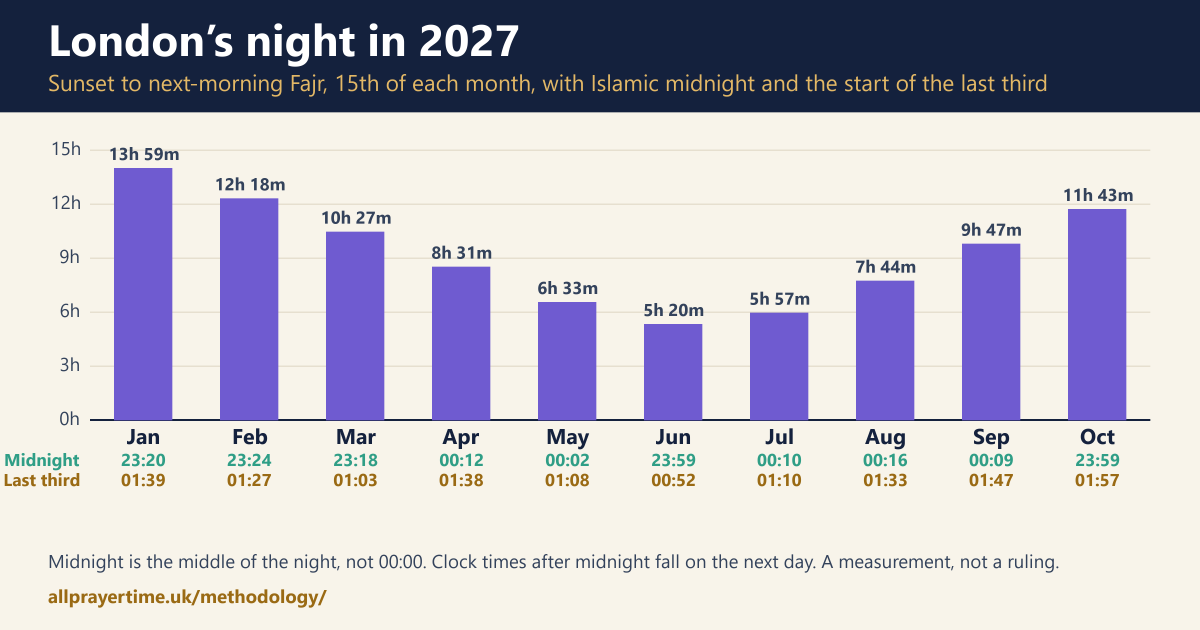
On the evening of 15 January 2027 in London, the sun sets at 16:20 and Fajr begins at 06:19 the next morning, so the night lasts 13h 59m. The Islamic midnight is the middle of that night, 23:20, and the last third of the night begins at 01:39. This guide explains how those two times are worked out, why two websites can give different answers for the same night, and what scholars say about them.
These are measurements of the night, not rulings. How the last third relates to a particular prayer, including Tahajjud, is a question for your scholars, and we publish no "Tahajjud time". This guide is not a religious ruling. For a question of fiqh, ask a qualified scholar, and follow your local mosque.
How the night is measured#
Every method starts by defining the night. The Darul Ifta Birmingham answer on calculating the last third of the night says it begins at sunset and continues until the break of dawn (Fajr), and that this time is divided into three equal parts, the third part being the last third. The IslamQA answer on the times of the prayers gives the same measure for the middle of the night: calculate the time between sunset and the break of true dawn, then divide it in half.
The night runs from sunset to Fajr the next morning.
Islamic midnight is the point half-way through it.
The last third begins two-thirds of the way through it, so the night's final third is the part that remains.
That is how our city pages work it out. We use the astronomical sunset (not the Maghrib time, which includes a safety margin) and the next morning's published Fajr, on real elapsed time.
What the hadith say#
When Isha's time lasts until. Abdullah ibn Amr reported that the Prophet ﷺ said: "When you pray Fajr, its time is until the first part of the sun appears. When you pray Zuhr, its time is until 'Asr comes. When you pray 'Asr, its time is until the sun turns yellow. When you pray Maghrib, its time is until the twilight has disappeared. When you pray 'Isha, its time is until half of the night has passed" (Sahih Muslim 612a).
The last third. Abu Huraira reported that the Prophet ﷺ said that our Lord "comes every night down on the nearest Heaven to us when the last third of the night remains, saying: 'Is there anyone to invoke Me, so that I may respond to invocation? Is there anyone to ask Me, so that I may grant him his request? Is there anyone seeking My forgiveness, so that I may forgive him?'" (Sahih al-Bukhari 1145).
When does Isha end? Scholars differ#
The phrase "until half of the night has passed" is understood in two ways, and both use the Islamic midnight as the point of reference:
Isha ends at midnight. The IslamQA answer on the five prayer times says the halfway point between sunset and true dawn is the end of the time for praying Isha.
Isha is valid until Fajr, but disliked after midnight. Darul Ifta Birmingham answers that the end of Isha is the beginning of Fajr, and that praying Isha after midnight is "disliked (makruh tanzih) and not prohibited".
For that reason our pages do not label midnight "Isha ends". They show the point and a note: scholars differ on Isha after this point: some say its time ends here; others, including the Hanafi school, that it remains valid until Fajr but is disliked after this point. Our guide to Isha time in the UK covers when Isha begins, and our guide to Fajr end time covers the other end of the night.
Why two websites give different midnights#
The most common reason is that the night is measured to sunrise instead of Fajr. PrayTimes, a widely copied calculation library, describes the legal midnight in its documentation as the midpoint between sunset and Fajr, yet its code defaults to a "Standard" mode that measures from sunset to sunrise. A site using that default shows a later midnight. The table compares the two for London, with the night measured as above (to Fajr) and to sunrise:
London, 2027 (evening of) | Sunset | Fajr next morning | Length of the night | Islamic midnight | Last third begins | Midnight if measured to sunrise | Difference |
|---|---|---|---|---|---|---|---|
15 Jan | 16:20 | 06:19 | 13h 59m | 23:20 | 01:39 (next day) | 00:08 (next day) | +48 min |
15 Feb | 17:15 | 05:33 | 12h 18m | 23:24 | 01:27 (next day) | 00:13 (next day) | +49 min |
15 Mar | 18:05 | 04:32 | 10h 27m | 23:18 | 01:03 (next day) | 00:07 (next day) | +49 min |
15 Apr | 19:57 | 04:28 | 8h 31m | 00:12 (next day) | 01:38 (next day) | 00:59 (next day) | +47 min |
15 May | 20:46 | 03:19 | 6h 33m | 00:02 (next day) | 01:08 (next day) | 00:55 (next day) | +53 min |
15 Jun | 21:19 | 02:39 | 5h 20m | 23:59 | 00:52 (next day) | 01:00 (next day) | +61 min |
15 Jul | 21:12 | 03:09 | 5h 57m | 00:10 (next day) | 01:10 (next day) | 01:06 (next day) | +56 min |
15 Aug | 20:24 | 04:08 | 7h 44m | 00:16 (next day) | 01:33 (next day) | 01:05 (next day) | +49 min |
15 Sep | 19:16 | 05:03 | 9h 47m | 00:09 (next day) | 01:47 (next day) | 00:55 (next day) | +46 min |
15 Oct | 18:08 | 05:51 | 11h 43m | 23:59 | 01:57 (next day) | 00:46 (next day) | +47 min |
The sunrise-based midnight comes 46 to 61 minutes later, and the gap is largest in summer, when Fajr is a long way before sunrise. The scholarly sources above all measure to Fajr, which is the method we use.
The night through the year, in three cities#
The night is longest in winter (13h 59m on 15 January in London) and shortest in summer (5h 20m on 15 June). Islamic midnight therefore moves through the year too, and in summer it can fall after 00:00, in which case we mark it "(next day)". The table shows four evenings for London, Manchester and Edinburgh. London uses the London Unified Prayer Timetable's Fajr from 1 January 2027, and the other cities use our calculated Fajr.
Evening of | City | Sunset | Fajr next morning | Length of the night | Islamic midnight | Last third begins |
|---|---|---|---|---|---|---|
21 Jan 2027 | London | 16:30 | 06:12 | 13h 42m | 23:21 | 01:38 (next day) |
21 Jan 2027 | Manchester | 16:30 | 06:05 | 13h 35m | 23:18 | 01:33 (next day) |
21 Jan 2027 | Edinburgh | 16:22 | 06:11 | 13h 49m | 23:17 | 01:35 (next day) |
20 Mar 2027 | London | 18:13 | 04:22 | 10h 09m | 23:18 | 00:59 (next day) |
20 Mar 2027 | Manchester | 18:22 | 04:29 | 10h 07m | 23:25 | 01:06 (next day) |
20 Mar 2027 | Edinburgh | 18:26 | 04:32 | 10h 06m | 23:29 | 01:10 (next day) |
21 Jun 2027 | London | 21:21 | 02:40 | 5h 19m | 00:01 (next day) | 00:54 (next day) |
21 Jun 2027 | Manchester | 21:42 | 03:40 | 5h 58m | 00:41 (next day) | 01:41 (next day) |
21 Jun 2027 | Edinburgh | 22:03 | 03:32 | 5h 29m | 00:47 (next day) | 01:42 (next day) |
23 Sep 2027 | London | 18:57 | 05:18 | 10h 21m | 00:08 (next day) | 01:51 (next day) |
23 Sep 2027 | Manchester | 19:06 | 05:16 | 10h 10m | 00:11 (next day) | 01:53 (next day) |
23 Sep 2027 | Edinburgh | 19:10 | 05:20 | 10h 10m | 00:15 (next day) | 01:56 (next day) |
On 21 June 2027 the night is only 5h 19m in London, so the last third begins at 00:54. In Manchester and Edinburgh our calculated Fajr is later, so the night is longer (5h 58m and 5h 29m) and the last third begins later, at 01:41 and 01:42.
Nights when the clocks change#
On the two nights a year when the clocks change, the night is an hour shorter or longer than the clock suggests. A calculation that just subtracts clock times gets the answer wrong. We measure the night in real elapsed time, so the figures below are correct for those nights.
Saturday 27 March 2027 (clocks go forward). Sunset is 18:25 and Fajr is 05:09 the next morning. The Islamic midnight is 23:17, and the last third begins at 00:54. Simple clock arithmetic would give 23:47 and 01:34, which is 30 minutes too late for midnight.
Saturday 30 October 2027 (clocks go back). Sunset is 17:38 and Fajr is 05:12 the next morning. The Islamic midnight is 23:55, where simple clock arithmetic would give 23:25, 30 minutes too early.
Where to find these times on AllPrayerTime.uk#
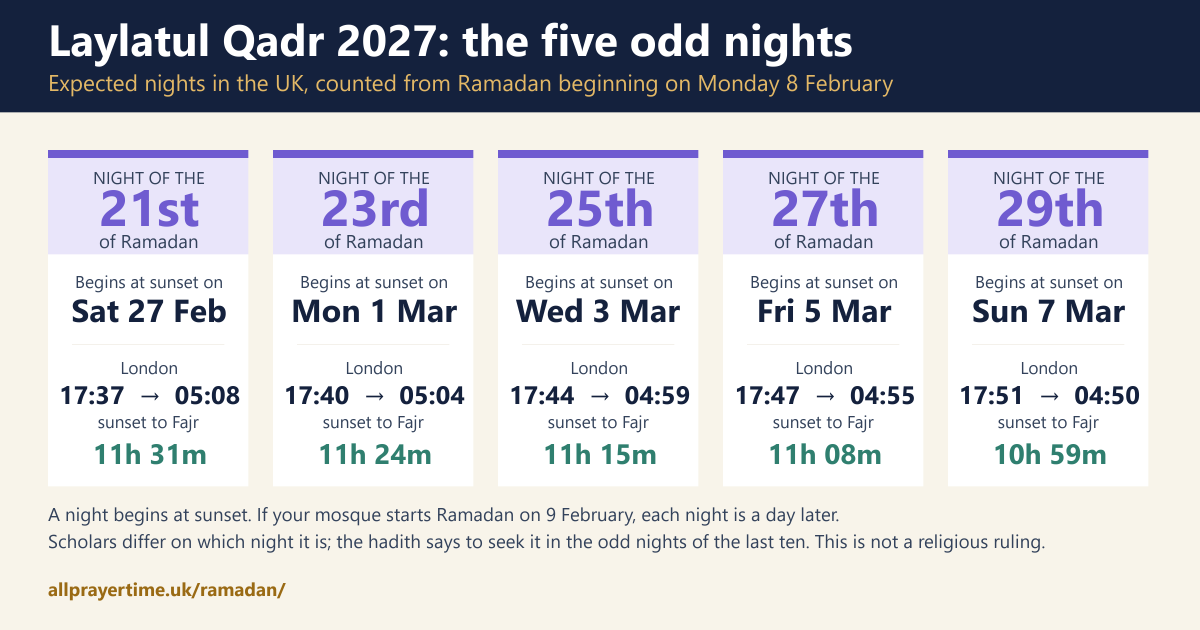
On each city page, a "Night" panel shows the Islamic midnight and the time the last third begins, measured from sunset to the next morning's Fajr, for today or any date you choose. They are explained on the methodology page. In the last ten nights of Ramadan, see our guide to Laylatul Qadr 2027 in the UK, which gives each odd night's midnight and last third for 12 cities.
Frequently asked questions#
What time is the last third of the night in the UK?#
It depends on the date and the city. In London on 15 January 2027 it begins at 01:39, and on 21 June 2027 at 00:54. Each city page shows it for any date.
Is Islamic midnight the same as 12 o'clock?#
No. It is the middle of the night between sunset and Fajr, so in London in winter it is before 12 (23:20 on 15 January 2027) and in summer it can be after 12 (00:01 on 21 June 2027).
When does Isha end?#
Scholars differ. Some say its time ends at the Islamic midnight; others, including the Hanafi school, that it lasts until Fajr but is disliked after midnight. Follow your scholars and your mosque.
Is the last third of the night the time for Tahajjud?#
The hadith above names the last third as a time when the Prophet ﷺ said our Lord calls on people to ask and seek forgiveness. How it relates to Tahajjud or any other prayer is for scholars to explain, so we publish when the last third begins and not a "Tahajjud time".
Why is my app's midnight later than yours?#
Many apps measure the night to sunrise rather than to Fajr. That gives a midnight 46 to 61 minutes later in London, as the table above shows.
Do the times change when the clocks change?#
The times are shown on the clock in use that night. On the nights the clocks change, we measure the night in real elapsed time, so the midnight and last third are correct.