The London Unified Prayer Timetable (LUPT) is a single prayer timetable for the whole of London inside the M25, created in 2011 by several London mosques and Islamic centres. From 1 January 2027, AllPrayerTime.uk shows it for London and Ilford, exactly as published at londonsalahtimes.com.
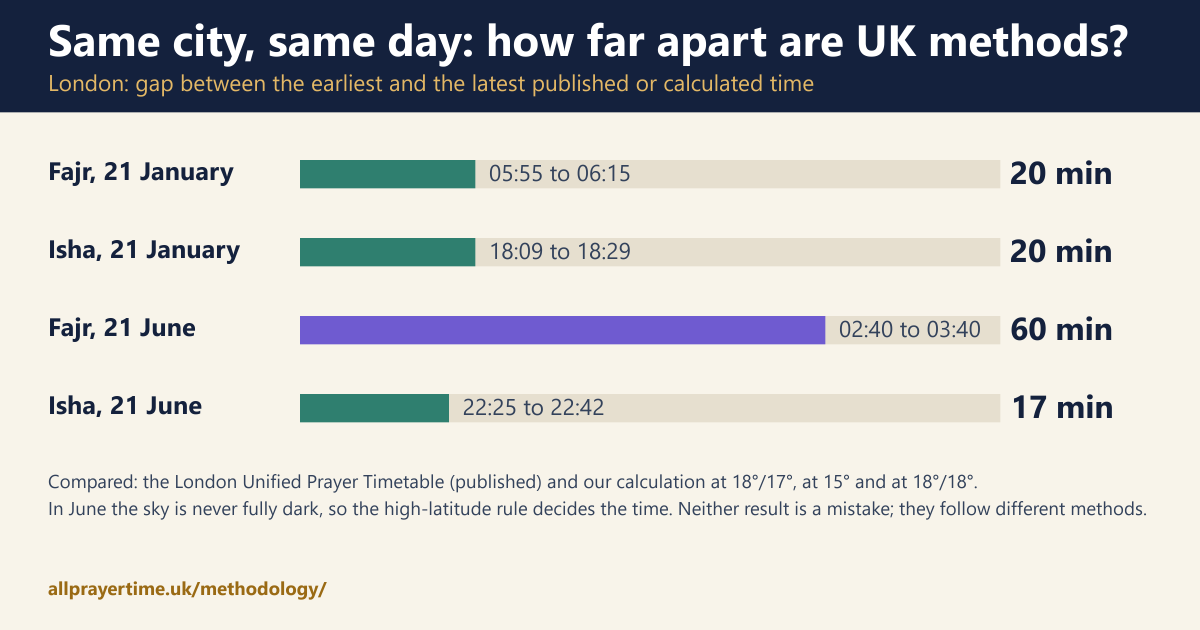
Its Dhuhr, Asr, Maghrib and sunrise times match a standard astronomical calculation to within a few minutes. Its Fajr and Isha do not: they come from UK observations, not a fixed angle, and that is where it differs from other timetables, by up to an hour in June. This guide explains how it works, how it compares with a calculated timetable across 2027, and what to make of the difference. It is not a ruling on which timetable to follow: for congregational prayer, follow your local mosque.
What is the London Unified Prayer Timetable?#
One timetable for London. It is calculated for Charing Cross (51.5073° N, 0.12755° W) and applied across the area inside the M25. The technical page says the times differ by about 100 seconds at the farthest east and west points.
Who produces it. The site says it was established in 2011 by several mosques and Islamic centres across London. It does not name them, and it does not say how many mosques follow it, so this guide makes no claim about that.
Both Asr times. It shows Asr for both mithl 1 (Shafi'i and others) and mithl 2 (Hanafi), in two columns.
Islamic dates. It shows Hijri dates from the Umm al-Qura calendar, and notes that Ramadan and Hajj dates follow the sighting of the new moon.
British Summer Time. Its times use British Summer Time when applicable.
Where to get it. The site has a monthly view, with a year selector, and an annual spreadsheet for 2027 (with a 12-hour and a 24-hour sheet) on its downloads page.
How its times are made#
The timetable's technical page describes two kinds of time:
Sunrise, Dhuhr, Asr and Maghrib are calculated. Solar noon and sunset come from standard astronomical formulae, with sunset at the usual horizon angle of -0.833°. A few minutes' margin is then added: sunrise 3 minutes earlier, Zuhr 5 minutes later (an allowance to avoid zawal), Asr 2 minutes later and sunset 3 minutes later. The site gives these as allowances for the east–west spread, elevation and refraction.
Fajr and Isha are observed. They are "based on the UK observations of Hizbul Ulama", who determined the intervals between Fajr and sunrise and between sunset and Isha. No twilight angle or number of minutes is given for either. Darul Ifta Birmingham describes observations made in 1987 to 1988 by Maulana Yakub Miftahi of the Hizbul-Ulama group, which suggested the twilight angle varied between about 12 and 16 degrees. The timetable does not say which observations it uses, and it does not publish them.
How it compares with a calculated timetable in 2027#
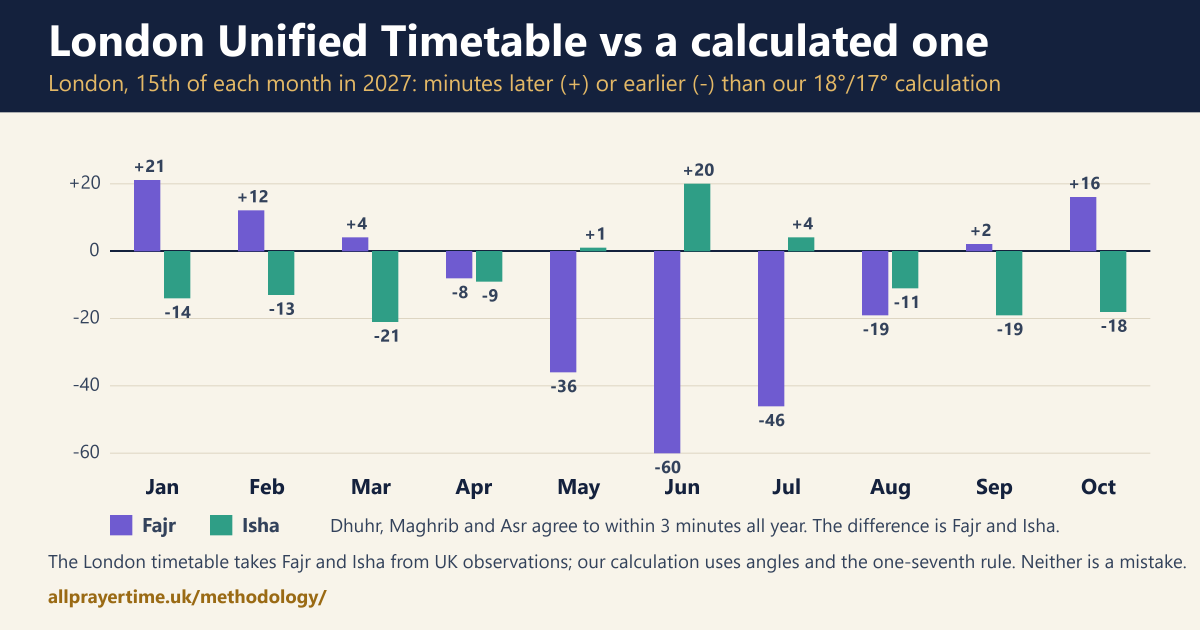
To see exactly where the London Unified Prayer Timetable differs from a calculated one, we compared its published London times with our own calculation (Fajr 18°, Isha 17°, Dhuhr 5 minutes after noon, Maghrib 3 minutes after sunset, and the one-seventh-of-the-night rule where the angle is not reached) for the 15th of each month from January to October 2027. A * marks a calculated time that is held by that rule, and a plus or minus shows whether the London timetable is later (+) or earlier (-) than our calculation.
London, 2027 | Fajr: London Unified Timetable | Fajr: our calculation | Fajr difference | Isha: London Unified Timetable | Isha: our calculation | Isha difference |
|---|---|---|---|---|---|---|
15 Jan | 06:20 | 05:59 | +21 min | 18:00 | 18:14 | -14 min |
15 Feb | 05:35 | 05:23 | +12 min | 18:48 | 19:01 | -13 min |
15 Mar | 04:35 | 04:31 * | +4 min | 19:28 | 19:49 * | -21 min |
15 Apr | 04:30 | 04:38 * | -8 min | 21:14 | 21:23 * | -9 min |
15 May | 03:21 | 03:57 * | -36 min | 21:58 | 21:57 * | +1 min |
15 Jun | 02:39 | 03:39 * | -60 min | 22:43 | 22:23 * | +20 min |
15 Jul | 03:08 | 03:54 * | -46 min | 22:23 | 22:19 * | +4 min |
15 Aug | 04:06 | 04:25 * | -19 min | 21:33 | 21:44 * | -11 min |
15 Sep | 05:00 | 04:58 * | +2 min | 20:34 | 20:53 * | -19 min |
15 Oct | 05:49 | 05:33 | +16 min | 19:34 | 19:52 | -18 min |
What the table shows:
Fajr. The London timetable is later than our 18° calculation by 2 to 21 minutes in autumn, winter and early spring, and earlier by up to 60 minutes between April and August, with the biggest gap in June (-60 minutes on 15 June).
Isha. The London timetable is earlier than our calculation by 9 to 21 minutes in most months, and later by up to 20 minutes in June (+20 minutes on 15 June).
Neither timetable is uniformly earlier or later. In winter our Fajr comes first, in summer the London timetable's does. For that reason we do not describe either as the "safer" one.
The rest of the day agrees closely. Across the 10 dates we compared, the London timetable's Dhuhr matched our calculation to the minute on 10 of 10 dates, its Maghrib differed by at most 1 minute, its Asr by at most 3 minutes (it publishes a 2 minute Asr allowance, and rounding can add a minute) and its sunrise by 3 minutes (the 3 minutes it takes off). Both timetables use the same 5-minute Dhuhr margin and 3-minute sunset margin; the difference is almost entirely Fajr and Isha.
Why the summer gap is so large#
In the summer months the sun does not get far enough below the UK horizon to reach 18° for Fajr or 17° for Isha on many nights. A calculated timetable needs a rule for those days; we use the one-seventh-of-the-night rule, which holds Fajr no earlier than the start of the last seventh of the night. An observation-based timetable follows what was observed instead. Neither is a mistake, and UK scholars do not agree a single national rule for the summer: Wifaqul Ulama's article on high latitudes concludes that "no agreed upon National solution can be proposed". Our guide to why UK prayer times differ sets out the other reasons, and our guide to Isha time in the UK covers the summer Isha.
Ramadan 2027 in London#
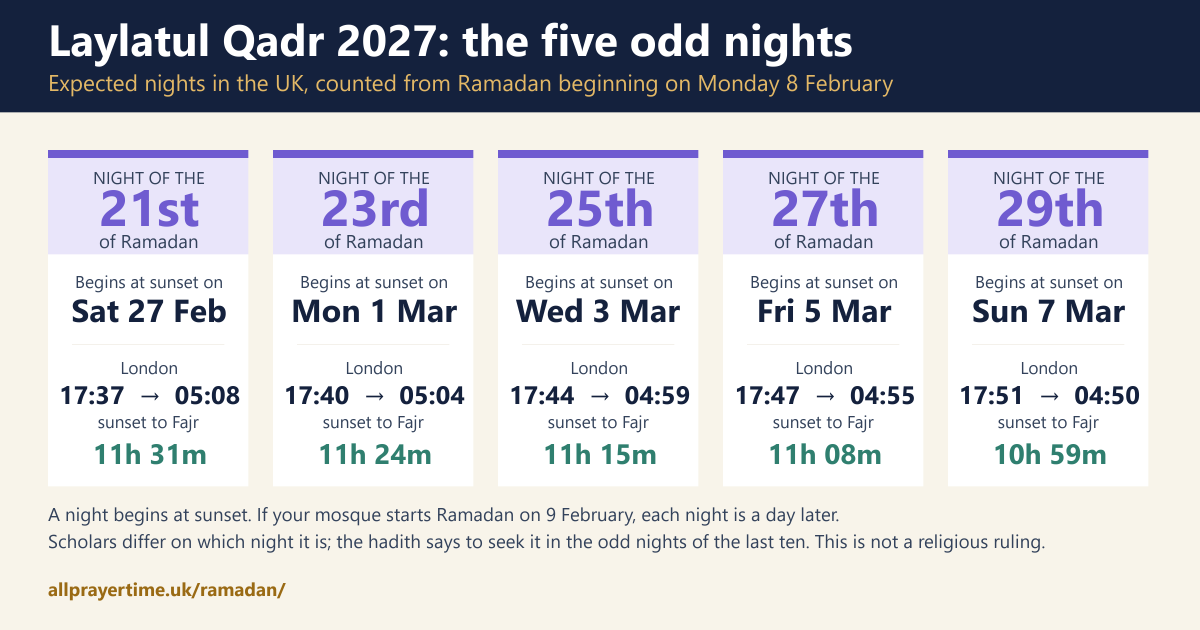
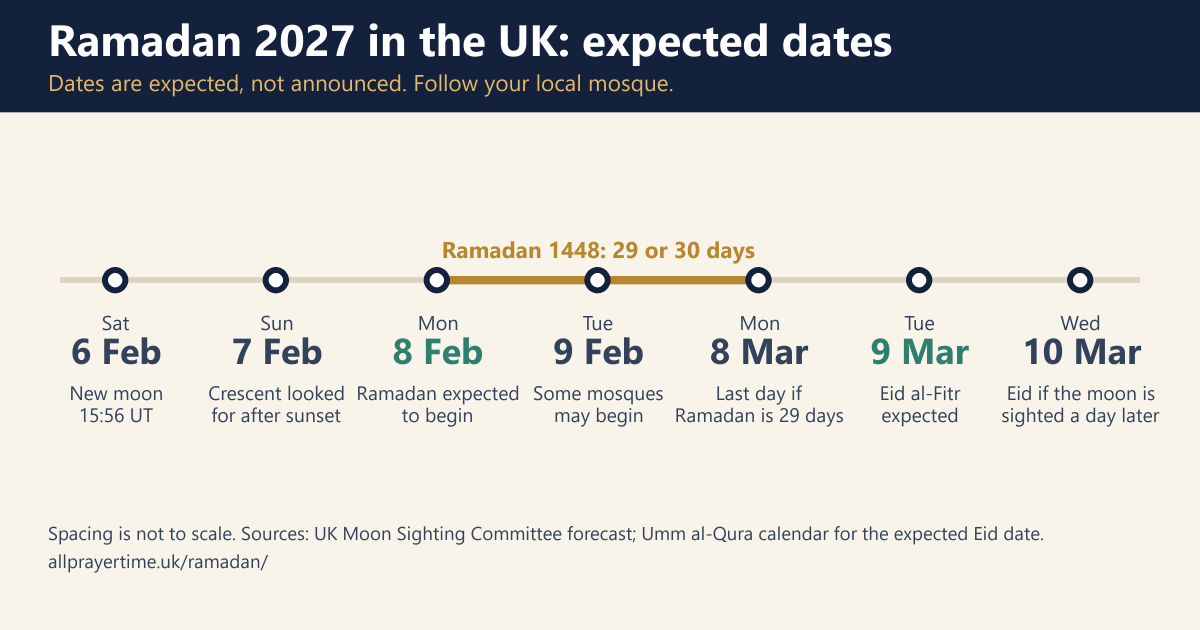
In Ramadan 2027, expected to begin on Monday 8 February, the London timetable's Fajr (the end of suhoor) is 05:47 on the first day, which is 13 minutes later than our 18° calculation, and 04:48 on 9 March, 7 minutes later. Its Isha is 18:37 on 8 February, 13 minutes earlier than ours. These are the times on our London Ramadan timetable. For how long the fast lasts, see our guide to Ramadan 2027 fasting hours.
What changes on AllPrayerTime.uk from 1 January 2027#
London and Ilford show the London Unified Prayer Timetable exactly as published, with no recalculation and no rounding of our own, and we cite londonsalahtimes.com as the source.
Dates up to 31 December 2026 stay on our calculated timetable, because the timetable has no 2026 data.
Every other city remains calculated from its own coordinates. Each city page explains which method it uses, and our methodology page gives the full detail.
The London page shows both Asr times and the Maghrib time (sunset plus the timetable's 3 minute margin), as the timetable does.
Which mosques follow it?#
The timetable's own site does not list the mosques that use it, so we cannot tell you whether yours does. Many London mosques publish their own timetables or congregation times. If your mosque's times differ from the London Unified Prayer Timetable or from ours, follow your mosque.
Frequently asked questions#
What is the London Unified Prayer Timetable?#
A single prayer timetable for London inside the M25, established in 2011 by several London mosques and Islamic centres, with calculated Dhuhr, Asr, Maghrib and sunrise times and observation-based Fajr and Isha times.
Is it the same all over London?#
Yes. It is calculated for Charing Cross and used for the whole area inside the M25. The site says the real difference to the farthest east and west points is about 100 seconds.
Why does my mosque's Fajr differ from the London timetable?#
Mosques choose their own Fajr method: some follow a 15 degree or 18 degree angle, some use UK observations and some publish their own timetable. See our guide to why UK prayer times differ. Follow your mosque.
Does it show both Asr times?#
Yes: mithl 1 (Shafi'i and others) and mithl 2 (Hanafi). We show both as well.
Where can I download the London Unified Prayer Timetable?#
From londonsalahtimes.com. Its downloads page offers an annual spreadsheet, currently for 2027. We do not provide a download of it.
Why did AllPrayerTime.uk switch London to it?#
Because it is the timetable that London mosques created for London, and we would otherwise have shown different Fajr and Isha times from it on many days of the year. It is a choice of method, not a correction: neither timetable is wrong.