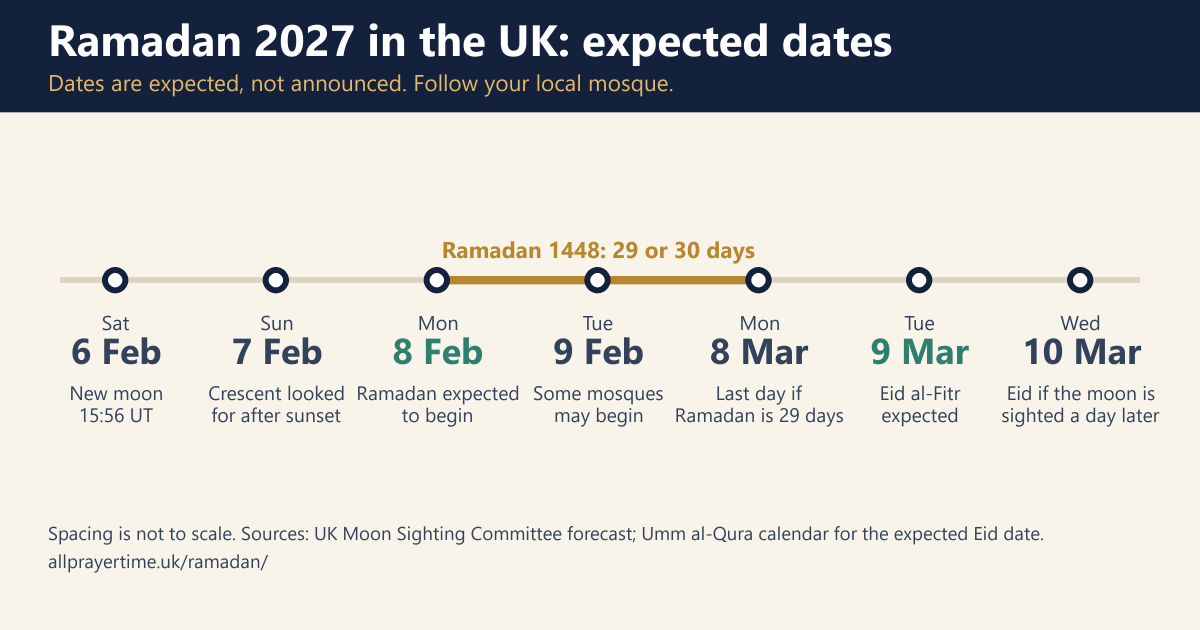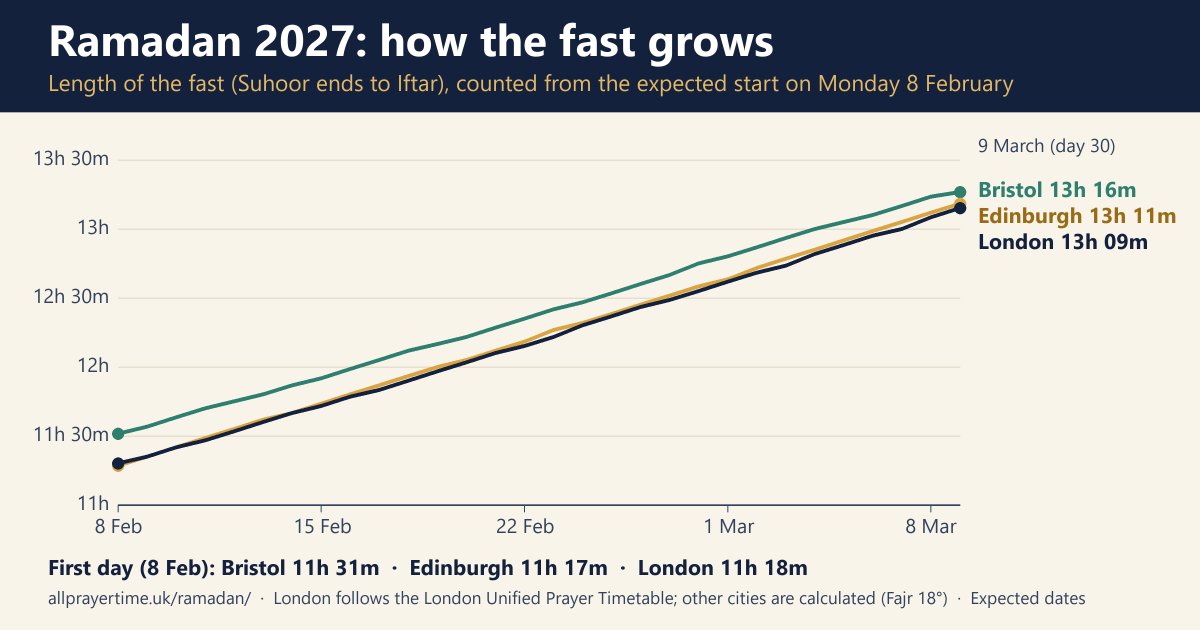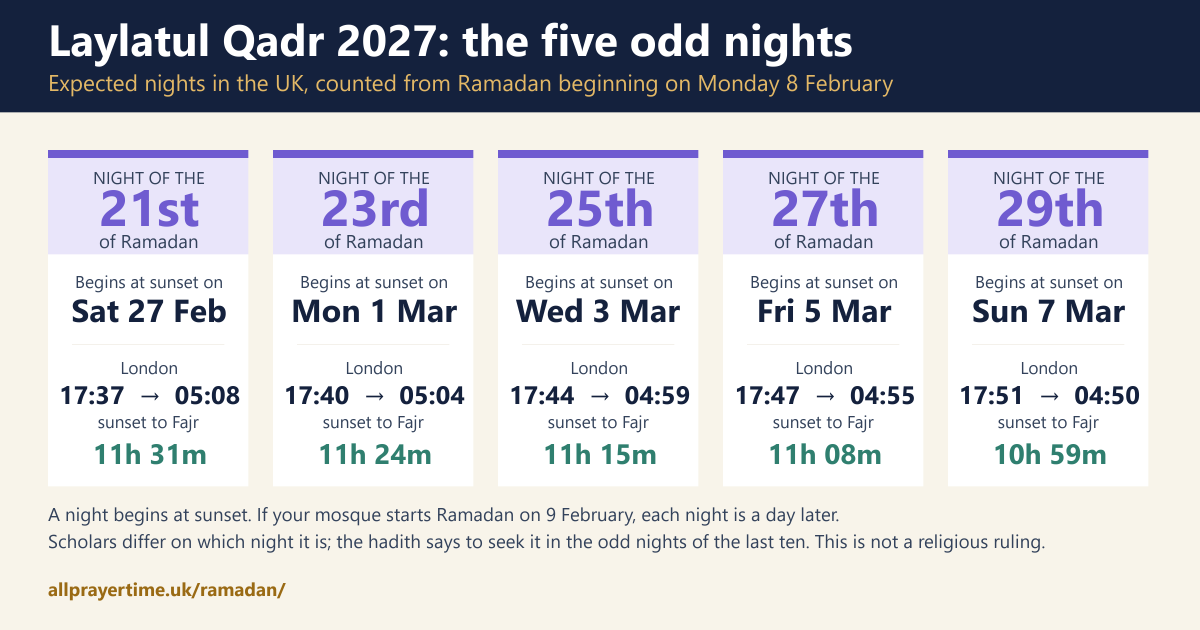
Laylatul Qadr, the Night of Decree, is expected to fall on one of the odd nights of the last ten of Ramadan 2027. If Ramadan begins on Monday 8 February 2027 as expected, those nights begin at sunset on Saturday 27 February, Monday 1 March, Wednesday 3 March, Friday 5 March and Sunday 7 March. If your mosque begins Ramadan a day later, each of them is a day later too.
Scholars have long differed on exactly which night it is, and this page does not decide that. What it does is give you the facts you need to plan: the dates, the exact times each night begins and ends in 12 UK cities, what the Quran and the hadith say, and the main scholarly views. It is not a religious ruling. For a question of fiqh, ask a qualified scholar, and follow your local mosque.
Laylatul Qadr 2027: the odd nights in the UK#
In the Islamic calendar a day begins at sunset, so the "night of the 27th" comes before the day of the 27th. That is why each night below begins on the evening of the day before. The table counts from the expected first day of Ramadan, Monday 8 February 2027, and also shows the evening of each night if Ramadan begins on Tuesday 9 February. The times are for London.
Night of Ramadan | Evening of | Sunset | Fajr next morning | Length of the night | Islamic midnight | Last third begins | Same night if Ramadan starts 9 Feb |
|---|---|---|---|---|---|---|---|
21st | Sat 27 Feb | 17:37 | 05:08 | 11h 31m | 23:22 | 01:18 (next day) | Evening of Sun 28 Feb |
23rd | Mon 1 Mar | 17:40 | 05:04 | 11h 24m | 23:22 | 01:16 (next day) | Evening of Tue 2 Mar |
25th | Wed 3 Mar | 17:44 | 04:59 | 11h 15m | 23:21 | 01:14 (next day) | Evening of Thu 4 Mar |
27th | Fri 5 Mar | 17:47 | 04:55 | 11h 08m | 23:21 | 01:12 (next day) | Evening of Sat 6 Mar |
29th | Sun 7 Mar | 17:51 | 04:50 | 10h 59m | 23:20 | 01:10 (next day) | Evening of Mon 8 Mar |
London follows the London Unified Prayer Timetable. For every other city, and for each date, see that city's own Ramadan 2027 timetable.
What is Laylatul Qadr?#
Laylatul Qadr is the night on which the Quran was sent down. The Quran names it in Surah al-Qadr (97), which has five verses. In the Saheeh International translation:
"Indeed, We sent the Qur'an down during the Night of Decree. And what can make you know what is the Night of Decree? The Night of Decree is better than a thousand months. The angels and the Spirit descend therein by permission of their Lord for every matter. Peace it is until the emergence of dawn." (Quran 97:1–5)
Surah ad-Dukhan describes the same event as "a blessed night" on which "every precise matter" is made distinct (Quran 44:3–4). The Quran does not name the night's date.
Which night is Laylatul Qadr? What the sources say#
The Prophet ﷺ pointed his community to the last ten nights of Ramadan and, within them, to the odd nights:
The odd nights. Aisha reported that the Prophet ﷺ said: "Search for the Night of Qadr in the odd nights of the last ten days of Ramadan" (Sahih al-Bukhari 2017).
The last ten nights. Aisha also said that he used to practise i'tikaf in the last ten nights of Ramadan and would say: "Look for the Night of Qadr in the last ten nights of the month of Ramadan" (Sahih al-Bukhari 2020).
The 27th. The Companion Ubayy ibn Ka'b swore that he knew it was the night before the morning of the twenty-seventh, and said its sign was that the sun rises bright that day without rays (Sahih Muslim 762a). This is the strongest source behind the common belief in the 27th night. It is a Companion's own conclusion, and scholars have read it in different ways.
The odd nights of the last ten are the 21st, 23rd, 25th, 27th and 29th. Beyond that, scholars differ. In a well-known answer by Shaykh Faraz Rabbani on SeekersGuidance, the positions reported include:
It is most likely in the last ten nights, with the odd nights more likely, and the 27th the most likely of them.
Imam al-Shafi'i is reported to have said it is most likely the 21st, then the 23rd, then the 27th.
Imam al-Nawawi followed al-Muzani and Ibn Khuzayma in holding that it moves around within the last ten nights.
Malik, al-Shafi'i, Ahmad and the majority, as reported by al-Nafrawi, held that it is not one fixed night and that it moves around.
The established position of Abu Hanifa and his two students is that it falls within Ramadan; a further position transmitted from Abu Hanifa is that it moves around the whole year. Ibn Abidin, quoting Ibn Arabi, notes that the opinions reach 46 different positions.
Al-Sarakhsi recorded that most of the Companions held it to be the 27th night, which others explain as its most likely night.
The practical conclusion many scholars draw is the one the hadith itself gives: seek it throughout the last ten nights, and make the odd nights a priority. That also answers the UK's own difficulty, because mosques do not all begin Ramadan on the same day (see below).
How long is each of these nights in the UK?#
The night is shorter each time. In London the night of the 21st lasts 11h 31m from sunset to Fajr, and the night of the 29th 10h 59m, about 8 minutes shorter with every odd night. On the night of the 27th, starting on Friday 5 March, the length of the night across the 12 cities we publish runs from 10h 59m in Luton to 11h 08m in London.
The table gives each city's figures for that night. "Islamic midnight" is the point half-way between sunset and the next morning's Fajr, and "Last third begins" is when the final third of that same night starts. These are measurements of the night, not rulings: how they relate to any particular prayer is a matter for your scholars.
City | Sunset (Fri 5 Mar) | Fajr (Sat 6 Mar) | Length of the night | Islamic midnight | Last third begins |
|---|---|---|---|---|---|
17:55 | 05:01 † | 11h 06m | 23:28 | 01:19 (next day) | |
17:47 | 04:55 | 11h 08m | 23:21 | 01:12 (next day) | |
17:47 | 04:55 | 11h 08m | 23:21 | 01:12 (next day) | |
17:52 | 04:54 † | 11h 02m | 23:23 | 01:13 (next day) | |
17:55 | 04:56 † | 11h 01m | 23:25 | 01:16 (next day) | |
17:54 | 04:55 † | 11h 01m | 23:25 | 01:15 (next day) | |
17:53 | 04:55 † | 11h 02m | 23:24 | 01:14 (next day) | |
17:57 | 04:58 † | 11h 01m | 23:28 | 01:18 (next day) | |
17:50 | 04:51 † | 11h 01m | 23:20 | 01:11 (next day) | |
17:52 | 04:52 † | 11h 00m | 23:22 | 01:12 (next day) | |
17:48 | 04:47 † | 10h 59m | 23:18 | 01:07 (next day) | |
17:57 | 04:56 † | 10h 59m | 23:26 | 01:16 (next day) |
A † after a Fajr time means that on that morning our calculated Fajr is held to the start of the last seventh of the night (the one-seventh adjustment), because at UK latitudes the sky does not always reach the Fajr angle in the way the calculation assumes. It is a calculation rule, not a religious ruling, and it is explained on the methodology page. London and Ilford, which follow the London Unified Prayer Timetable, carry no mark.
If your mosque starts Ramadan a day later#
Mosques in the UK begin Ramadan on different days, depending on their method (see our guide to when Ramadan 2027 starts in the UK). The UK Moon Sighting Committee's forecast is that Ramadan is most likely to start on 8 February 2027, but a mosque that follows a later announcement or a local sighting may begin on 9 February.
Count the odd nights from your mosque's first day. If yours is 9 February, the five nights begin on the evenings of Sunday 28 February, Tuesday 2 March, Thursday 4 March, Saturday 6 March and Monday 8 March, as in the last column of the first table. The times for each date are on your city's Ramadan page. Each date is a day later than the matching night in the table, so sunset is about 1.5 to 2 minutes later and Fajr about 2 to 2.5 minutes earlier.
How the last ten nights are spent#
These points come from the sources above and are offered as information, not as a ruling:
Night prayer. Abu Huraira reported that the Prophet ﷺ said: "whoever stood for the prayers in the night of Qadr out of sincere Faith and hoping for a reward from Allah, then all his previous sins will be forgiven" (Sahih al-Bukhari 2014, and similarly 1901).
I'tikaf. The Prophet ﷺ practised i'tikaf in the last ten nights (Sahih al-Bukhari 2020). I'tikaf arrangements are set by each mosque, so ask yours.
A supplication. Aisha asked what she should say if she knew which night it was. He ﷺ told her to say: "Allāhumma innaka ʿafuwwun karīmun tuḥibbul-ʿafwa faʿfu ʿannī", "O Allah, indeed You are Pardoning, Generous; You love to pardon, so pardon me" (Jami at-Tirmidhi 3513, graded Sahih by Ahmad Shakir and al-Albani and Hasan Sahih by Bashar Awad Maarouf).
Worship across the whole of the last ten. The SeekersGuidance answer advises seeking it in the last ten nights with worship, prayer, du'a and dhikr, and keeping the obligatory prayers, including Isha and Fajr in congregation for men, as the foundation.
Taraweeh, qiyam and i'tikaf times are set by each mosque and are not on our timetables, so check your mosque's own notices.
Frequently asked questions#
Is Laylatul Qadr on the 27th night?#
Many scholars consider the 27th the most likely night, and Ubayy ibn Ka'b swore to it (Sahih Muslim 762a). Others hold that it is not one fixed night and that it moves between the odd nights, a view reported from Malik, al-Shafi'i, Ahmad and the majority. The hadith itself tells us to seek it in the odd nights of the last ten, which is why scholars advise not limiting yourself to one night.
When are the odd nights in 2027?#
If Ramadan begins on Monday 8 February 2027, they begin at sunset on Saturday 27 February, Monday 1 March, Wednesday 3 March, Friday 5 March and Sunday 7 March. If your mosque starts on 9 February, each is a day later.
When does the night begin and end?#
It begins at sunset and lasts until dawn, as in the Quran's "until the emergence of dawn" (97:5). In London on the night of the 27th, that is from 17:47 on Friday 5 March until Fajr at 04:55 on Saturday 6 March.
Is it the same night everywhere?#
Not necessarily in practice. Each place counts its nights from its own start of Ramadan, and mosques in the UK do not all start on the same day. Follow your mosque's start date and count the odd nights from there.
What should I say if I find Laylatul Qadr?#
Aisha was taught: "Allāhumma innaka ʿafuwwun karīmun tuḥibbul-ʿafwa faʿfu ʿannī" (Jami at-Tirmidhi 3513). The Arabic is: اللَّهُمَّ إِنَّكَ عَفُوٌّ كَرِيمٌ تُحِبُّ الْعَفْوَ فَاعْفُ عَنِّي.
Why do these times differ from my mosque's timetable?#
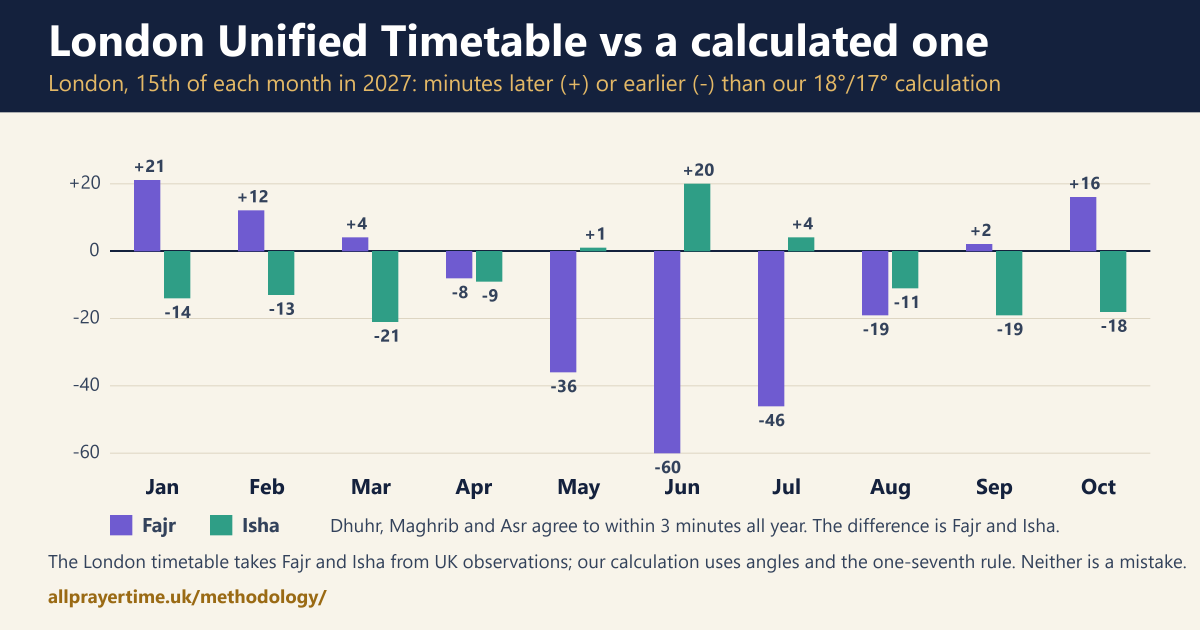
Sunset depends on where you are, and Fajr also depends on the method: mosques use different Fajr angles, margins and rounding, and some publish one fixed timetable for the whole month. Our night times use the astronomical sunset and the Fajr on our own city timetable. If your mosque's times differ, follow your mosque.