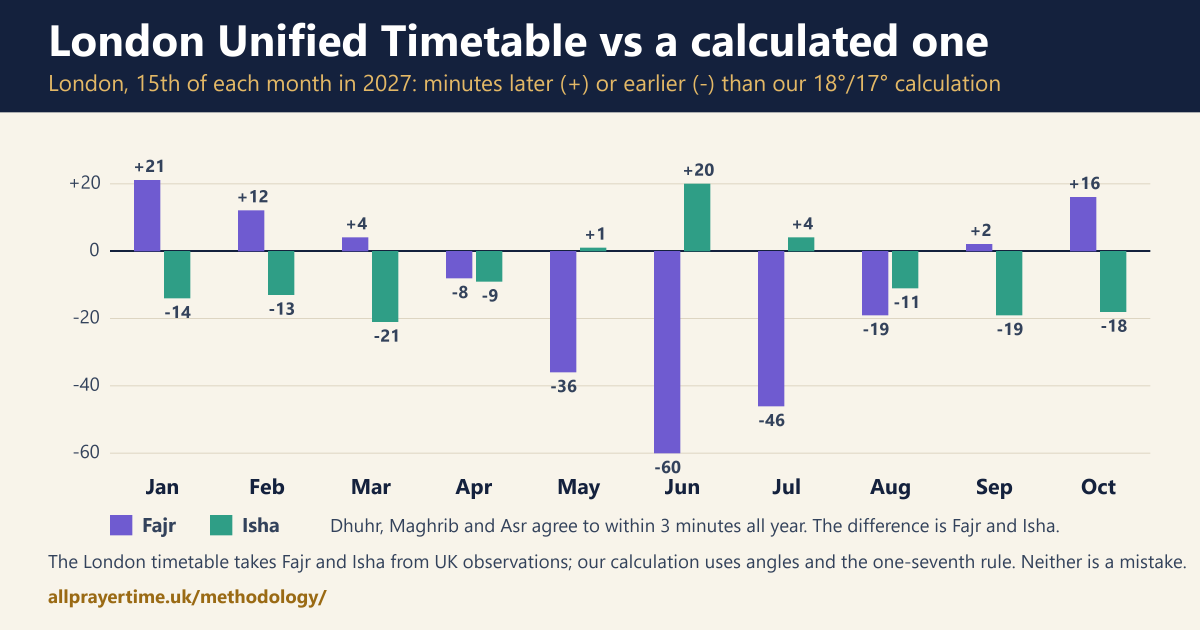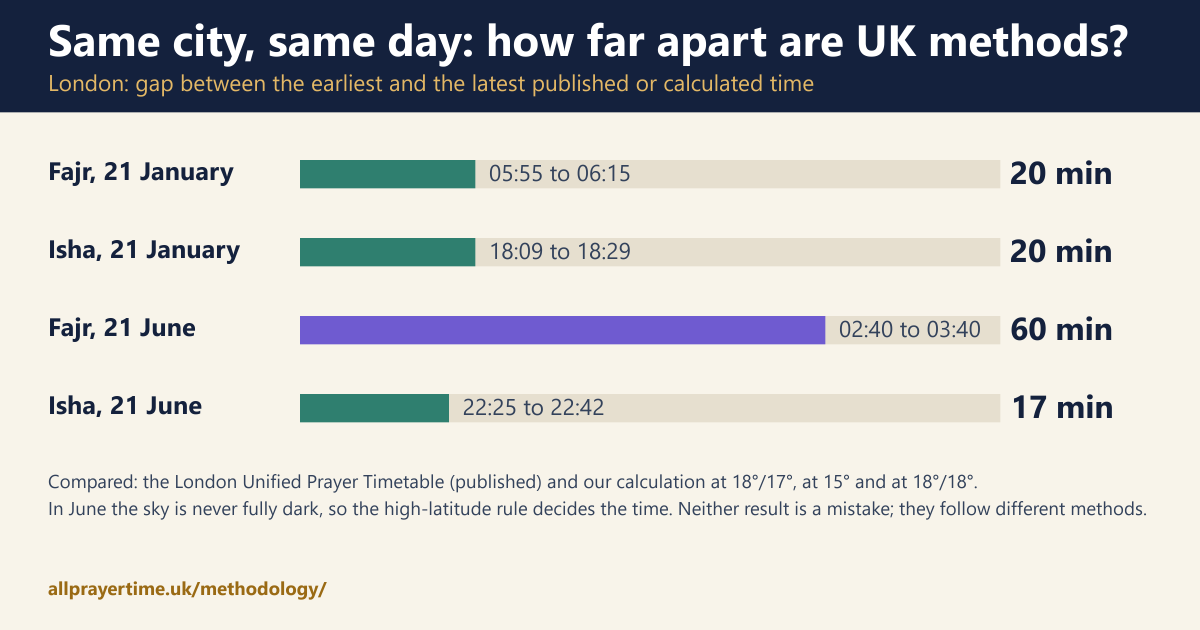
UK prayer times can differ by a minute or two between two good sources, and by up to an hour in June. On 21 June 2027 the London Unified Prayer Timetable puts Fajr in London at 02:40; our own calculation puts it at 03:40. Neither is a mistake. They follow different, published methods, and each is followed by people who consider it correct.
This guide explains the seven reasons your mosque's timetable, your phone app and this website may not match, with real figures for London, Manchester and Edinburgh. It does not tell you which method is right: that is a question for your scholars, and for congregational prayer you should follow your local mosque.
The short answer: seven reasons prayer times differ#
The Fajr angle. 18° gives a Fajr about 20 minutes earlier than 15° in January.
The Isha angle. In January, 15°, 17° and 18° give an Isha 20 minutes apart in London.
Summer and the high-latitude rule. In June the sky never gets fully dark in the UK, so the method used for that matters more than any angle.
Which Asr. The Hanafi and the other schools' Asr are 33 to 75 minutes apart in London across the year.
Safety margins. Publishers add 3 to 5 minutes after sunset and after noon.
Where you are. On the same evening sunset differs by 10 minutes across the 12 cities we publish.
What is being published. Many mosques publish the congregation time, not the start time, and publishers round differently.
1. The Fajr angle: 18°, 15° or observation#
Fajr begins at true dawn, and calculating it means choosing how far below the horizon the sun is at that moment. UK practice is not uniform. Darul Ifta Birmingham explains that many UK timetables rest on observations made by scholars in 1987 to 1988, which suggested the twilight angle varied between about 12 and 16 degrees, while other scholars held that Fajr begins at 18 degrees. It calls ending suhoor by the 18 degree timetable "more preferable and an act of precaution", and allows a 15 degree or observation-based timetable where 18 degrees is difficult.
Wifaqul Ulama calculates Fajr at 18 degrees, following the conclusion of a 1983 scholars' meeting in Bradford. The London Unified Prayer Timetable instead states that its Fajr is based on UK observations by Hizbul Ulama, with no angle given. The Moonsighting Committee Worldwide states that fixed angles fail at high latitudes and uses a latitude-and-season function, compared with an 18 degree calculation, taking the later of the two for Fajr.
The effect is easy to see on a winter day. In the table, the same calculation is run with only the angle changed:
City, 21 January 2027 | Fajr at 18° | Fajr at 15° | Fajr gap | Isha at 15° | Isha at 17° | Isha at 18° |
|---|---|---|---|---|---|---|
London | 05:55 | 06:15 | 20 min | 18:09 | 18:22 | 18:29 |
Manchester | 06:06 | 06:26 | 20 min | 18:15 | 18:28 | 18:35 |
Edinburgh | 06:13 | 06:34 | 21 min | 18:14 | 18:29 | 18:36 |
For Fajr, 18° comes out 20 to 21 minutes earlier than 15°. The London Unified Prayer Timetable published 06:14 for 21 January, within a minute of the 15 degree figure for that date, although that timetable is observation-based and is not an angle calculation.
2. The Isha angle#
Isha has the same problem, plus a second question: which twilight ends it. Wifaqul Ulama adopts 15 degrees for Isha in Britain for the whole year, reasoning from Ibn Abidin that 15 degrees for al-shafaq al-ahmar (the red twilight) corresponds to 18 degrees for al-shafaq al-abyad (the white twilight). The Moonsighting Committee Worldwide uses the red twilight in summer and the white in winter. The London Unified Prayer Timetable also gives UK observations rather than an angle.
Our own default is Fajr 18° and Isha 17°, the Muslim World League's figures. That is a product default, not a UK scholarly consensus, and we say so on the methodology page. In the table above, Isha runs from 18:09 at 15° to 18:29 at 18° in London on the same January evening.
3. Summer: when the sky does not get dark#
In the summer months the sun does not get far enough below the UK horizon to reach the Fajr and Isha angles on some nights, so every method needs a rule for those days. Wifaqul Ulama's article on high latitudes concludes that "no agreed upon National solution can be proposed" and lists several options, including limiting Isha to a fixed number of minutes after sunset, combining 15 degrees with the one-seventh rule, or fixing a time. Its article on Fajr says the one-seventh rule is "not viable for British Muslims". The Moonsighting Committee Worldwide uses the one-seventh rule from 55 degrees north. The London Unified Prayer Timetable uses its observations.
We use the one-seventh-of-the-night rule: Fajr is never earlier than the start of the last seventh of the night, and Isha never later than the end of the first seventh. This is a calculation choice, not a ruling. Here is how it plays out in London, with the published timetable beside our calculation (a * marks a time held by that rule):
London | Fajr: London Unified Timetable | Fajr: calculated at 18° | Fajr: calculated at 15° | Isha: London Unified Timetable | Isha: calculated at 17° | Isha: calculated at 15° |
|---|---|---|---|---|---|---|
21 Jan 2027 | 06:14 | 05:55 | 06:15 | 18:10 | 18:22 | 18:09 |
20 Mar 2027 | 04:24 | 04:22 * | 04:31 | 19:36 | 19:54 * | 19:46 |
21 Jun 2027 | 02:40 | 03:40 * | 03:40 * | 22:42 | 22:25 * | 22:25 * |
23 Sep 2027 | 05:16 | 05:06 * | 05:15 | 20:17 | 20:39 * | 20:30 |
The June row is the one to notice. Fajr differs by 60 minutes (02:40 against 03:40) on 21 Jun, and because the one-seventh rule decides both of our calculated times, they are identical at 15 degrees and at 18 degrees: in midsummer the angle makes no difference. Our guide to Isha time in the UK explains the summer Isha in more detail.
4. Which Asr: one shadow or two#
The Shafi'i, Maliki and Hanbali schools begin Asr when an object's shadow equals its length (plus its noon shadow), and the Hanafi school, following Abu Hanifa, when it equals twice its length. In an answer on SeekersGuidance, Shaykh Faraz Rabbani explains that within the Hanafi school the two students of Abu Hanifa, Abu Yusuf and Muhammad ibn al-Hasan, held the one-shadow time, and that both views are valid to follow when there is a need. Another SeekersGuidance answer notes the Hanafi time "enters a bit later than the Shafi'i one".
That is why we show both, and the gap is large in the UK:
London | Asr (Mithl 1) | Asr (Mithl 2) | Gap |
|---|---|---|---|
21 Jan 2027 | 14:11 | 14:44 | 33 min |
20 Mar 2027 | 15:27 | 16:17 | 50 min |
21 Jun 2027 | 17:27 | 18:42 | 75 min |
23 Sep 2027 | 16:12 | 17:02 | 50 min |
The London Unified Prayer Timetable and Wifaqul Ulama also publish both Asr times. See our Asr Mithl 1 and Mithl 2 guide for every city.
5. Safety margins#
Publishers add a few minutes so that a prayer is never started early. Sunset is made later for Maghrib, and solar noon for Dhuhr, and the sources do not all use the same amount:
Source | After solar noon (Dhuhr) | After sunset (Maghrib) | Fajr and Isha |
|---|---|---|---|
London Unified Prayer Timetable | +5 min | +3 min | UK observations (no angle stated) |
Moonsighting Committee Worldwide | +5 min | at least +3 min | Latitude-and-season functions compared with 18° |
Wifaqul Ulama | +4 min | +5 min | Fajr 18°; Isha 15° |
AllPrayerTime.uk (calculated cities) | +5 min | +3 min | Fajr 18°; Isha 17° (our default, not a consensus) |
The London Unified Prayer Timetable also lists a 2 minute delay for Asr and shows sunrise 3 minutes earlier than the calculated time. Wifaqul Ulama recommends five minutes after sunset because of uncertainty about refraction in Britain. A margin is a precaution, not a measurement, so two careful publishers can differ by up to two minutes on Maghrib or Dhuhr without either being wrong.
6. Where exactly you are#
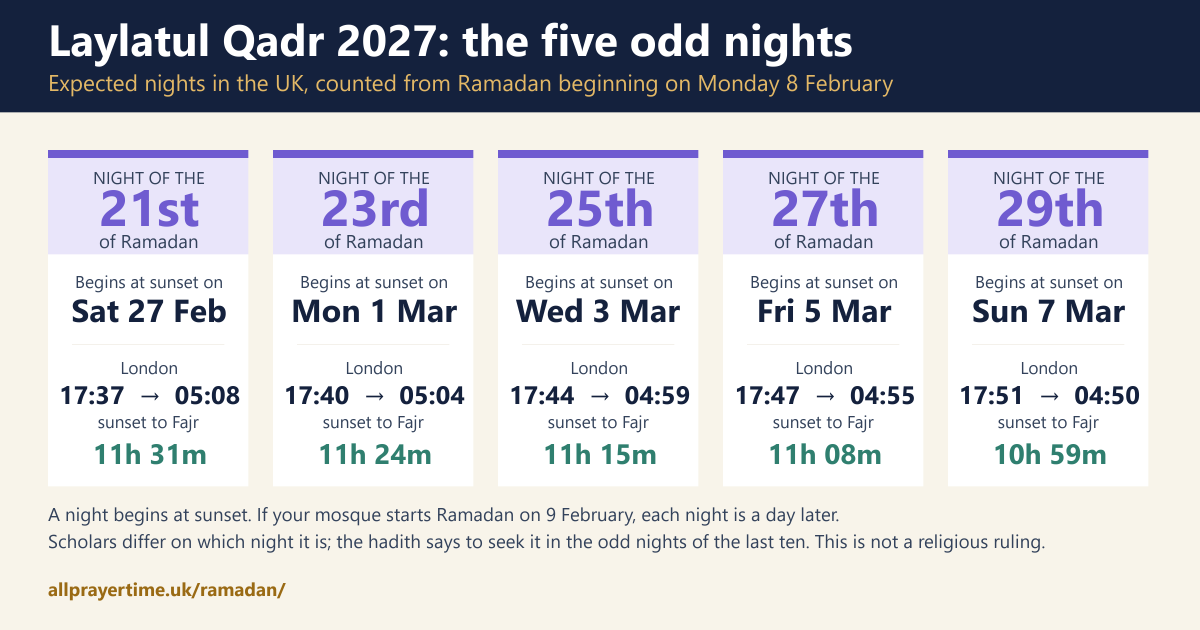
Prayer times depend on latitude and longitude. The London Unified Prayer Timetable is calculated for Charing Cross and applied across the area inside the M25, with about 100 seconds of difference at the farthest east and west points. Outside London, each of our cities is calculated for its own coordinates. On the evening of 5 March 2027 sunset runs from 17:47 in London to 17:57 in Liverpool and Bristol, 10 minutes apart, and a timetable calculated for the wrong town can be several minutes out.
7. Start time or congregation time, and rounding#
Many mosques publish a congregation (jamaat) time alongside, or instead of, the start time of each prayer. These are set by each mosque and will not match a calculated start time. Taraweeh, Eid prayer and other congregational times are set by each mosque and are not on our timetables.
Publishers also round differently. We keep full precision internally and round to the nearest minute once, at the point of display, which our methodology page documents. The London Unified Prayer Timetable states that its spreadsheet and script match exactly when rounded to the nearest minute, but does not say how its published times are rounded.
Which timetable should you follow?#
These are different published methods, not one right answer and several wrong ones. A practical rule: for congregational prayer, follow your local mosque, so that you pray with your community. If you pray at home, pick one trusted timetable that matches the method you follow and use it consistently. If you are unsure which method to follow, ask a qualified scholar. Neither this website nor any app can settle a question of fiqh.
How AllPrayerTime.uk produces its times#
London and Ilford show the London Unified Prayer Timetable exactly as published at londonsalahtimes.com from 1 January 2027, with no recalculation.
Every other city is calculated from its own coordinates with Fajr 18°, Isha 17°, Dhuhr 5 minutes after noon and Maghrib 3 minutes after sunset, with both Asr times shown and the one-seventh-of-the-night rule where the angle is not reached.
Adjusted times are marked with †, and no separate Imsak time is published.
The full explanation is on the methodology page, and each city's timetable is at prayer times by city.
Frequently asked questions#
Why is my mosque's Fajr later than your website's?#
Most likely because of the Fajr method: a 15 degree or observation-based timetable gives a later Fajr than 18 degrees, by about 20 minutes in January. Follow your mosque.
Which Fajr angle is correct?#
UK scholars and organisations differ. Some follow 18 degrees, some 15 degrees, and some use UK observations. We cannot rule on it: please ask a qualified scholar, and follow your local mosque.
Why is Isha so late in June?#
Because in a UK summer the sky does not get fully dark, so the Isha angle is never reached on some nights and each method uses a rule instead. See our guide to Isha time.
Which Asr should I pray?#
Both are recognised. SeekersGuidance advises that both positions are sound, and that a Hanafi who prays with a congregation that prays at the earlier time may follow it when there is a need. Follow your school or your mosque.
Why do two apps differ by a minute or two?#
Usually because of rounding, safety margins (Maghrib 3 or 5 minutes, for example) or slightly different coordinates.
Do UK mosques agree on one timetable?#
No. London has a unified timetable followed by many mosques inside the M25, but across the UK mosques and organisations use different methods, and Wifaqul Ulama notes there is no agreed national solution for the summer months.