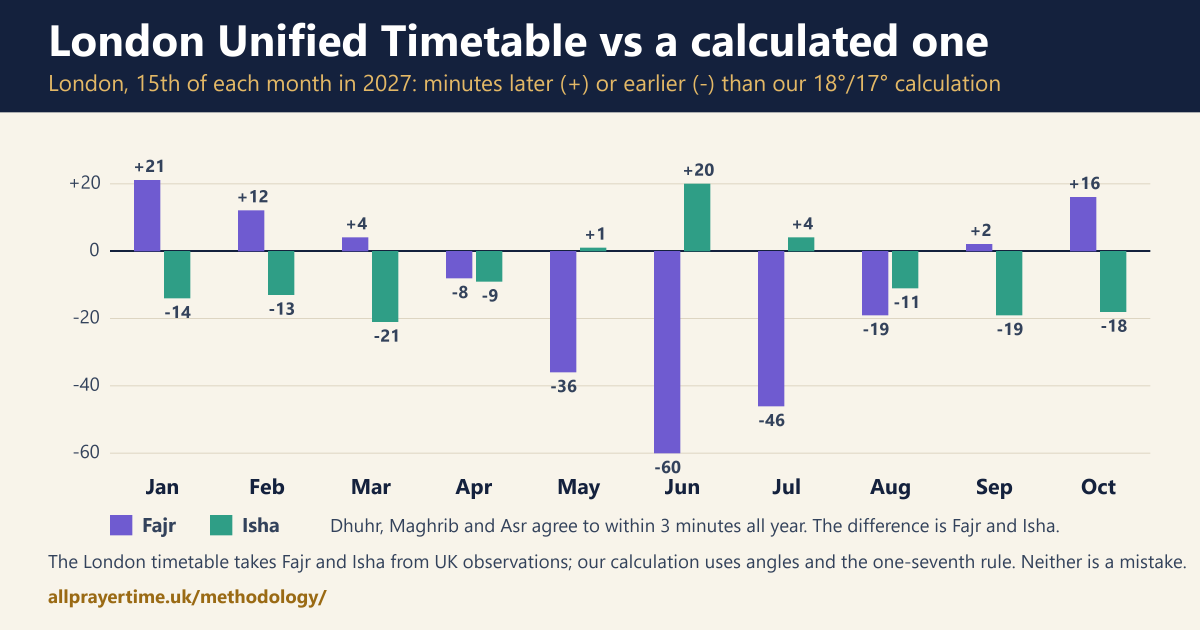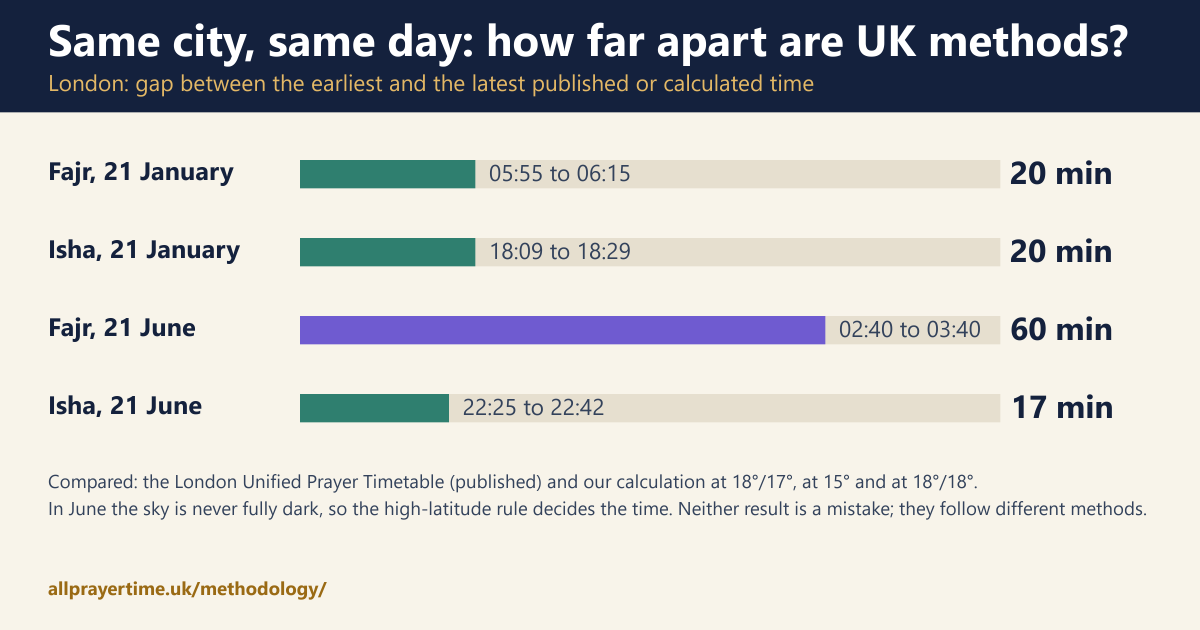
On 21 June 2027 in Edinburgh the sun sets at 22:03 and we publish Isha at 22:58, only 0h 52m after Maghrib. In London on the same date the London Unified Prayer Timetable has Isha at 22:42, 1h 18m after Maghrib. Same night sky, same country, a gap of 0h 26m in how soon Isha begins. This guide explains why Isha is the hardest prayer time to publish in the UK in summer, how our pages work it out, and what scholars have said.
This is a calculation guide, not a religious ruling. Scholars differ on Isha in the UK, and Wifaqul Ulama says no national solution has been agreed. Follow your local mosque's timetable for when you pray.
Why summer Isha is a problem in the UK#
Isha is defined by the sky: its time begins when twilight has gone. In midsummer in the UK the sun never gets far enough below the horizon, so twilight can last all night, or Isha would come very late. Wifaqul Ulama describes the two problems as "perpetual twilight" and Isha that "happens extremely late". Every UK timetable has to make a choice for those weeks, and the choices differ.
Our default calculation uses a 17° twilight angle for Isha. In summer that angle is either never reached or is reached very late, so we apply a limit: Isha is never later than the end of the first seventh of the night. PrayTimes, the calculation library behind many apps, describes the method this way: the period between sunset and sunrise is divided into seven parts and Isha begins after the first part.
What our pages publish on the longest day#
21 June 2027 | Sunset | Maghrib | Isha as published | Maghrib to Isha | How Isha is set |
|---|---|---|---|---|---|
London | 21:21 | 21:24 | 22:42 | 1h 18m | London Unified Prayer Timetable |
Bristol | 21:31 | 21:34 | 22:34 | 1h 00m | 17° not reached: one-seventh rule sets Isha |
Manchester | 21:42 | 21:45 | 22:41 | 0h 56m | 17° not reached: one-seventh rule sets Isha |
Edinburgh | 22:03 | 22:06 | 22:58 | 0h 52m | 17° not reached: one-seventh rule sets Isha |
Bristol, Manchester and Edinburgh use our calculated times: on 21 June the 17° angle is not reached in any of them, so the one-seventh rule sets Isha. That gives 1h 00m after Maghrib in Bristol, 0h 56m in Manchester and 0h 52m in Edinburgh. London follows the London Unified Prayer Timetable from 1 January 2027 and its Isha is later.
Isha through the summer#
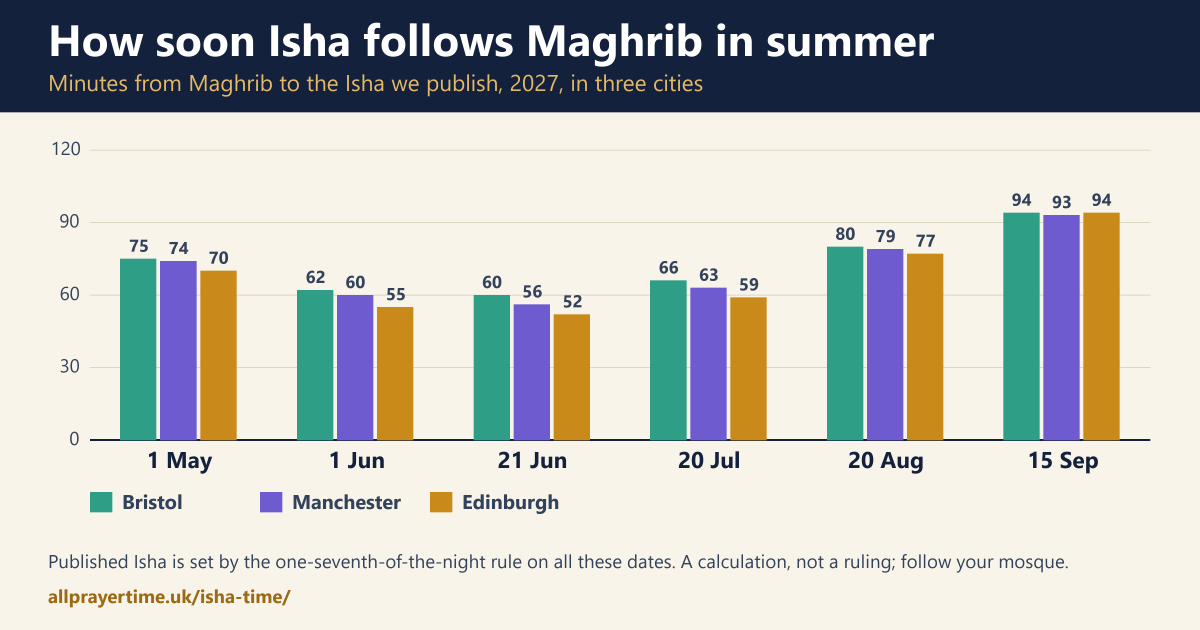
The next table follows three cities from 1 May to 15 September. Where the 17° angle does occur but falls outside the limit, we show it beside the published time. We sampled six dates in each of Bristol, Manchester and Edinburgh. On all 18 of those rows the published Isha was set by the one-seventh rule: 8 times because 17° was not reached, and 10 times because the 17° time would have been later than the limit.
Date (2027) | City | Maghrib | Isha as published | Maghrib to Isha | 17° time, where it exists | How Isha is set |
|---|---|---|---|---|---|---|
1 May | Bristol | 20:36 | 21:51 | 1h 15m | 22:51 | One-seventh limit applied |
1 Jun | Bristol | 21:21 | 22:23 | 1h 02m | — | 17° not reached: one-seventh rule sets Isha |
21 Jun | Bristol | 21:34 | 22:34 | 1h 00m | — | 17° not reached: one-seventh rule sets Isha |
20 Jul | Bristol | 21:19 | 22:25 | 1h 06m | 00:22 (next day) | One-seventh limit applied |
20 Aug | Bristol | 20:26 | 21:46 | 1h 20m | 22:29 | One-seventh limit applied |
15 Sep | Bristol | 19:29 | 21:03 | 1h 34m | 21:14 | One-seventh limit applied |
1 May | Manchester | 20:41 | 21:55 | 1h 14m | 23:11 | One-seventh limit applied |
1 Jun | Manchester | 21:30 | 22:30 | 1h 00m | — | 17° not reached: one-seventh rule sets Isha |
21 Jun | Manchester | 21:45 | 22:41 | 0h 56m | — | 17° not reached: one-seventh rule sets Isha |
20 Jul | Manchester | 21:27 | 22:30 | 1h 03m | — | 17° not reached: one-seventh rule sets Isha |
20 Aug | Manchester | 20:30 | 21:49 | 1h 19m | 22:44 | One-seventh limit applied |
15 Sep | Manchester | 19:29 | 21:02 | 1h 33m | 21:20 | One-seventh limit applied |
1 May | Edinburgh | 20:55 | 22:05 | 1h 10m | 23:53 | One-seventh limit applied |
1 Jun | Edinburgh | 21:50 | 22:45 | 0h 55m | — | 17° not reached: one-seventh rule sets Isha |
21 Jun | Edinburgh | 22:06 | 22:58 | 0h 52m | — | 17° not reached: one-seventh rule sets Isha |
20 Jul | Edinburgh | 21:45 | 22:44 | 0h 59m | — | 17° not reached: one-seventh rule sets Isha |
20 Aug | Edinburgh | 20:41 | 21:58 | 1h 17m | 23:12 | One-seventh limit applied |
15 Sep | Edinburgh | 19:34 | 21:08 | 1h 34m | 21:35 | One-seventh limit applied |
For example, in Bristol on 20 July the 17° angle would put Isha at 00:22 (after midnight, so the next day), and we publish 22:25. In Edinburgh on 20 August it would be 23:12 and we publish 21:58. Across these 18 rows the published gap between Maghrib and Isha ranges from 0h 52m to 1h 34m.
What UK scholars say#
Which twilight. Wifaqul Ulama's paper on Isha at high latitudes says the start of Isha can be set at the disappearance of red twilight, which it calls a sound opinion within the Hanafi school, and that this corresponds to an angle of 15°. It lists scholars who adopt 15° for Isha in Britain. Our default, by contrast, is 17°. It is a product default, not a UK consensus, and our methodology page explains it.
When twilight does not end. The same paper states that "no agreed upon National solution can be proposed since this is a grey area", and lists four options: limit Isha to 65 minutes after astronomical sunset on the longest day; take the earlier of 15° and one-seventh of the night (the view it attributes to London ulama); lock Isha at a fixed time such as 23:00; or leave it to local ulama for their own communities.
Our one-seventh limit is close to the second option, but we publish it with a 17° angle rather than 15°, so the numbers are not the same as that option would give. Mosque timetables may follow any of these options, so jama'ah times can differ from ours.
When does Isha end?#
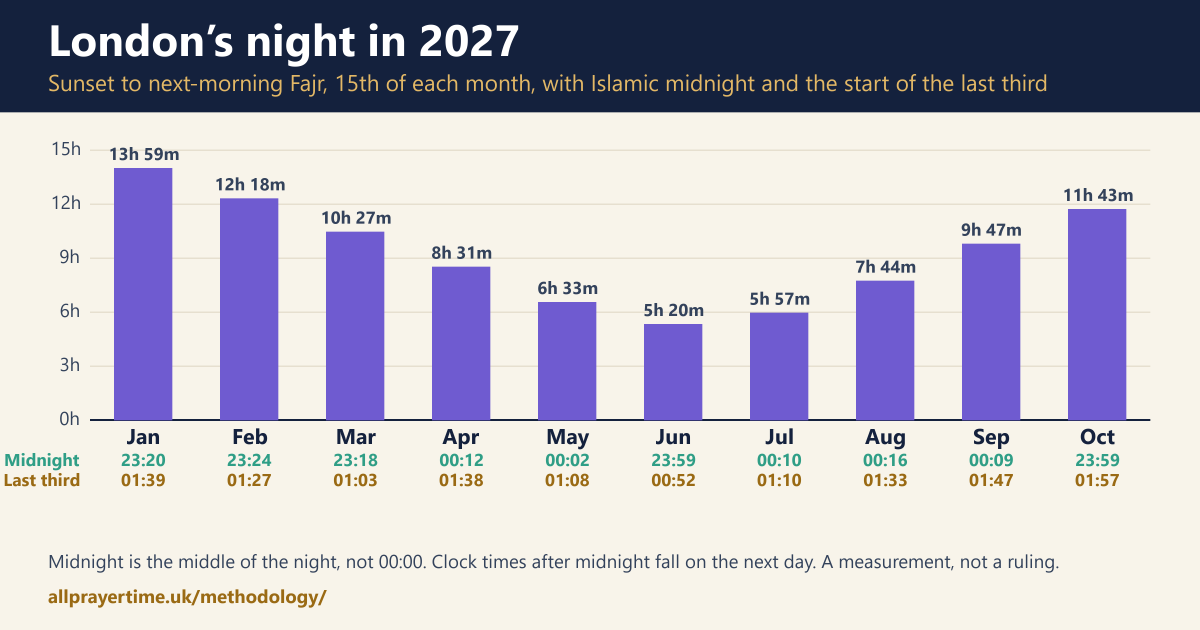
Abdullah ibn Amr reported that the Prophet ﷺ said: "When you pray 'Isha, its time is until half of the night has passed" (Sahih Muslim 612a). For how scholars differ on what that means, and for the Islamic midnight in the UK, see Islamic midnight and the last third of the night.
How to use this#
For when you pray in summer, use your mosque's timetable. Our time is a calculated one.
Check the date on your Isha time page: where a limit applies, the city page says so and shows the angle-based time next to it.
To see why UK timetables differ more widely, read why UK prayer times differ.
Frequently asked questions#
What time is Isha in the UK in June?#
On 21 June 2027 we publish 22:34 in Bristol, 22:41 in Manchester and 22:58 in Edinburgh. London shows 22:42 from the London Unified Prayer Timetable.
Why is Isha so soon after Maghrib in Edinburgh?#
Because the 17° angle is not reached in midsummer, so the one-seventh-of-the-night limit sets Isha. In Edinburgh on 21 June that is 0h 52m after Maghrib.
Is there a UK-wide agreed Isha time in summer?#
No. Wifaqul Ulama says no agreed national solution can be proposed. Follow your mosque.
Why is London's Isha later than yours elsewhere?#
London uses the London Unified Prayer Timetable from 1 January 2027, which has its own Isha. Other cities use our calculation with the one-seventh limit.
Does Isha come after midnight in the UK?#
The 17° angle can fall after midnight in some places and dates, as in Bristol on 20 July 2027. The time we publish is earlier, because of the limit.
Is this a fatwa?#
No. It explains how a calculated time is worked out. Ask a scholar for rulings.