Yes and no. When the UK clocks change, every prayer time shown on a clock moves by exactly one hour, but the prayers themselves do not move: they are set by the sun. In London on Sunday 28 March 2027, Fajr is at 05:09, against 04:10 the day before. Remove the hour and the real shift is −1 minute. This guide explains what changes, what does not, and what to check when the clocks change in 2026 and 2027.
When the clocks change#
The UK government's page on clock changes states the rule: the clocks go forward 1 hour at 1am on the last Sunday in March, and back 1 hour at 2am on the last Sunday in October. The period when the clocks are an hour ahead is British Summer Time (BST). When they go back, the UK is on Greenwich Mean Time (GMT). According to the same page, the dates are:
25 October 2026: clocks go back (GMT).
28 March 2027: clocks go forward (BST).
31 October 2027: clocks go back (GMT).
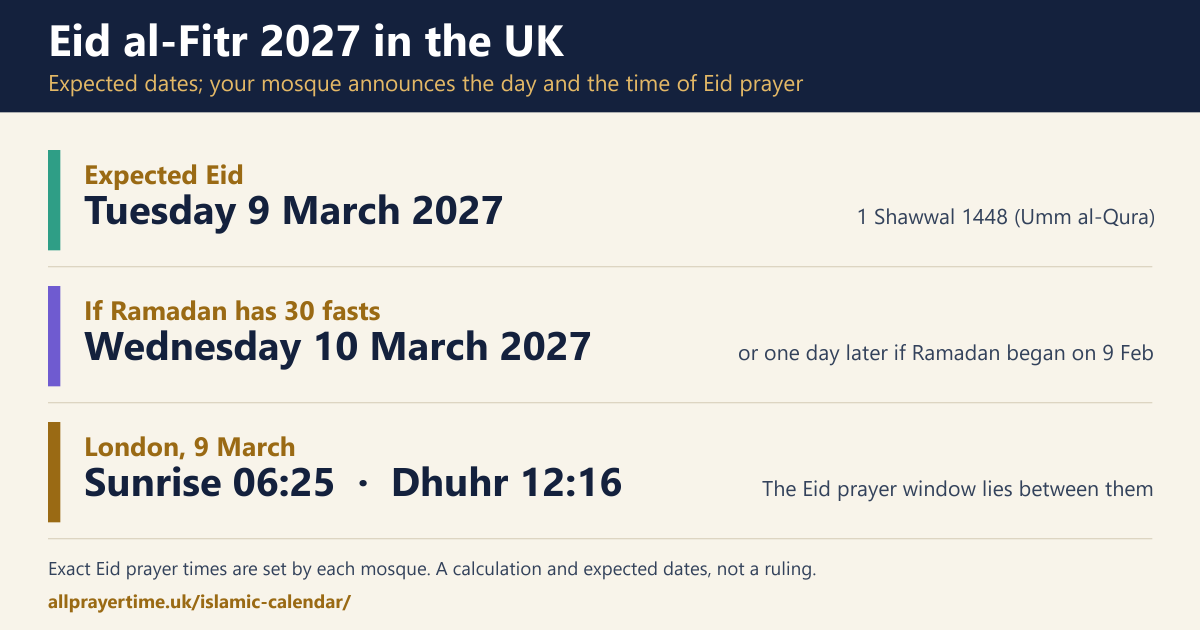
On the Umm al-Qura calendar Eid al-Fitr 2027 is expected on 9 March, 19 days before the clocks go forward, so the whole of Ramadan 2027 falls on GMT. See Islamic dates in 2027. The current arrangement is set in law by the Summer Time Order 2002, according to Wikipedia's article on British Summer Time.
Why the sun does not follow the clock#
Prayer times follow the sun, and BST only relabels the clock by one hour. Solar midday, which is what Dhuhr is measured from, is close to 12:00 on GMT in winter and so about 13:00 on a BST clock in summer. In London our published Dhuhr is 12:11 on 27 March 2027 and 13:11 the next day, and it includes a 5-minute safety margin, so it is a few minutes after solar midday. The sun is in the same place; only the label has changed.
What the numbers show#
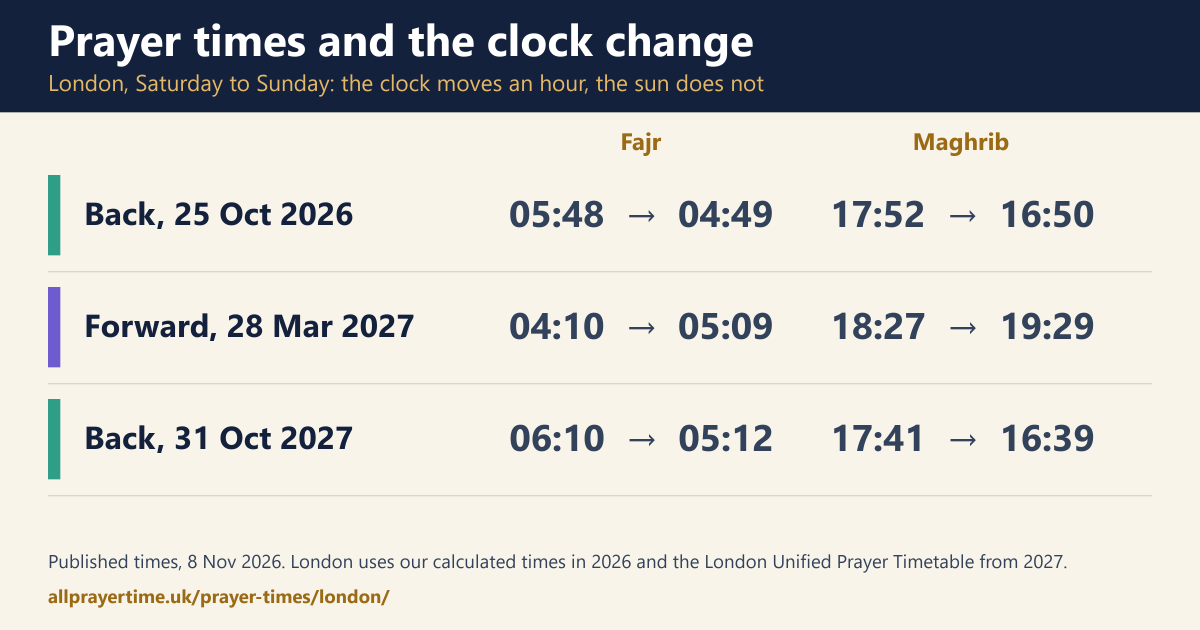
The table compares the published London times on the Saturday and the Sunday of each clock change. The first change (25 October 2026) has already happened. The last column removes the one-hour jump, to show how far the prayer actually moved in a day. London uses our calculated times in 2026 and the London Unified Prayer Timetable from 1 January 2027.
London | Prayer | Saturday | Sunday | Change on the clock | Change after removing the hour |
|---|---|---|---|---|---|
Saturday 24 to Sunday 25 October 2026 | Fajr | 05:48 | 04:49 | −59 min | +1 min |
Sunrise | 07:40 | 06:42 | −58 min | +2 min | |
Dhuhr | 12:50 | 11:50 | −60 min | 0 min | |
Asr (Mithl 1) | 15:18 | 14:16 | −62 min | −2 min | |
Maghrib | 17:52 | 16:50 | −62 min | −2 min | |
Isha | 19:34 | 18:32 | −62 min | −2 min | |
Saturday 27 to Sunday 28 March 2027 | Fajr | 04:10 | 05:09 | +59 min | −1 min |
Sunrise | 05:44 | 06:42 | +58 min | −2 min | |
Dhuhr | 12:11 | 13:11 | +60 min | 0 min | |
Asr (Mithl 1) | 15:34 | 16:35 | +61 min | +1 min | |
Maghrib | 18:27 | 19:29 | +62 min | +2 min | |
Isha | 19:45 | 20:47 | +62 min | +2 min | |
Saturday 30 to Sunday 31 October 2027 | Fajr | 06:10 | 05:12 | −58 min | +2 min |
Sunrise | 07:47 | 06:49 | −58 min | +2 min | |
Dhuhr | 12:49 | 11:49 | −60 min | 0 min | |
Asr (Mithl 1) | 15:11 | 14:10 | −61 min | −1 min | |
Maghrib | 17:41 | 16:39 | −62 min | −2 min | |
Isha | 19:08 | 18:06 | −62 min | −2 min |
Every prayer jumps by about an hour on the clock, and after that hour is removed, what is left is the ordinary day-to-day drift of a minute or two as the days lengthen or shorten.
Fajr and Maghrib in three cities#
Clock change | City | Fajr (Sat → Sun) | Maghrib (Sat → Sun) |
|---|---|---|---|
Forward, 28 March 2027 | London | 04:10 → 05:09 | 18:27 → 19:29 |
Forward, 28 March 2027 | Manchester | 04:18 → 05:16 | 18:38 → 19:40 |
Forward, 28 March 2027 | Edinburgh | 04:20 → 05:18 | 18:43 → 19:45 |
Back, 31 October 2027 | London | 06:10 → 05:12 | 17:41 → 16:39 |
Back, 31 October 2027 | Manchester | 06:05 → 05:07 | 17:44 → 16:42 |
Back, 31 October 2027 | Edinburgh | 06:10 → 05:11 | 17:40 → 16:38 |
Things to check when the clocks change#
Fajr on the Sunday morning. When the clocks go forward, Fajr appears an hour later on your clock (London 04:10 to 05:09), and the sun has not moved. When they go back, it appears an hour earlier (06:10 to 05:12), so an alarm set by habit can wake you after Fajr.
Printed timetables. A mosque timetable may have separate columns for each period, or a footnote saying where it changes. Check the Sunday row.
Jumu'ah and jama'ah times. Mosques set their own, and may keep the clock time or move it. Ask your mosque.
Phone apps. A phone that follows UK time moves its clock itself; a fixed alarm you set by hand does not move with the sun.
The night in between. On the clock-change night the night is an hour shorter or longer than it looks, which affects the Islamic midnight. See Islamic midnight and the last third of the night.
On any city page you can open the date you need and read the time for that day. See the list of cities.
Frequently asked questions#
Do prayer times change when the clocks go forward?#
The clock reading of each prayer moves forward by one hour, because the clock has moved. The prayers themselves are set by the sun and do not move.
When do the clocks change in 2027?#
They go forward on 28 March 2027 and back on 31 October 2027, according to the UK government.
Which prayer is most affected?#
All of them equally on the clock. The one people notice most is Fajr, because the change happens overnight and the first morning is the one when an alarm is wrong. In London, Fajr is 05:09 on 28 March 2027 and 05:12 on 31 October 2027.
Why are my app's times different on the Sunday?#
Because the clock changed overnight. Check that the app is set to UK time and not a fixed offset.
Is this a fatwa?#
No. It explains what happens to the times when the clocks change. For when you pray, follow your mosque.